Friday, 30 December 2011

Imran Khan

Imran Khan Biography
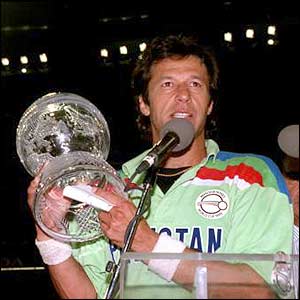
Born Imran Khan Niazi into a proud pathan family of landowners. Best know internationally as Imran Khan also known as the Lion of Lahore, he is probably the finest cricketer to come from Pakistan. An outstanding all rounder, he became a national hero when he captained the Pakistan Cricket team to victory and brought back the World Cup in the 1991/92 Cricket World Cup which took place in Australia.

Part of a family that produced many cricketers from his maternal side, amongst which is Majid Khan who was also a Pakistan Captain as well as Javed Burqi.

Imran grew up in Lahore and was educated at Aitchison College in Lahore. His parents placed great emphasis on education and ensured that Imran received the best. He attended the Royal Grammar School in Worcester and then went on to Keble College, Oxford.

He captained the Oxford University Cricket Team and played for Worchester and then Sussex. He captained Pakistan from 1982 till 1988, when he decided to quit cricket while he was still at the top of his career.
When the then President General Zia Ul Haq appealed to Imran to rejoin the team as they needed his expertise and leadership. Imran returned to the Cricketing World and finally left cricket after bringing back the only ever World Cup trophy to Pakistan in 1992.

Imran Khan was the world's most charismatic cricketer, a heart throb to many drooling female fans, that were more enthralled with his stunning good looks and physique than his cricketing abilities. He received many proposals of marriage and had numerous affairs with many socialites all over the world.

Being a very religious man, many expected him to marry a lady of his own faith but he surprised the world when in 1995 at the age of 43, this charasmatic bachelor who always managed to escape marraige, married millionaire James Goldsmiths daughter Jemima in a Muslim ceremony on May 16 1995 in Paris, France, then in a civil ceremony in Richmond, on June 21st of the same year.

Jemima converted to the Islamic faith and was named Haiqa Khan. She was a good, close friend of the late Lady Diana Spencer. Jemima gave birth to a baby boy, named Suleiman Issa, on 18 November 1996 in London.

Imran Khan has been implicated in a peternity suit by former Girlfriend Sita White, however Imran denies being the father of a girl named Tyrian Jade. A Los Angeles court has however ruled by default, that Imran is the father.

Imran and Jemima have a second baby son, born on 10th April 1999, in London, England. They have named him Qassim.

Since giving up cricket Imran has devoted his time to raising funds for the Shaukat Khanum Memorial Cancer clinic in memory of his late mother, who lost her battle against cancer. He Imran has realised his dream and the Shaukat Khanum Memorial Cancer Clinic is a one of its kind cancer clinic in Pakistan.

Currently Imran is pursuing a political career, He campaigns under the party name 'Tehrik - E - Insaaf'. Many believe he would have won the last elections, but the conservative Pakistani people felt that he had betrayed them by marrying a non muslim and the fact that she was a Jewish lady, was a plot by the Americans to get Pakistan under American power. Imran is still devoting his time and energy to politics and his popularity has once again grown in part due to the success of his marraige as well as the fact that he has the Pakistani peoples best interests at heart.
Imran Khan

Imran Khan
Imran Khan
Imran Khan
Imran Khan
Imran Khan
Imran Khan
Imran Khan
Imran Khan at his best
Imran Khan The Great Assest of Pakistan Forever.....!

Wasim Akram

Wasim Akram Biography
Wasim Akram (Urdu: وسيم اکرم) (born June 3, 1966 in Lahore, Punjab) is a former Pakistani cricketer. He was a left-arm fast bowler and left-handed batsman, who represented the Pakistani cricket team in Tests and One Day Internationals. Widely regarded as one of the finest fast bowlers ever, Akram holds world records for the most wickets taken in List A cricket (881), and is second only to Muttiah Muralitharan in terms of ODI wickets (502). He is considered to be one of the pioneers of reverse swing bowling.[1][2][3] The revolutionary nature of reverse swing initially resulted in accusations of ball tampering, although reverse swing has now been accepted as a legitimate feature of the game. Akram's later career was also tarnished with accusations of match fixing, although these remain unproven.
Wasim Akram
Wasim Akram
Wasim Akram
Wasim Akram
Wasim Akram
Wasim Akram 
Wasim Akram
Wasim Akram
Wasim Akram Magic Ball - To Rahul Dravid
WASIM AKRAM - MAGIC BALL TO ADAM GILCHRIST 2002

Thursday, 29 December 2011

Shahid Afridi

Shahid Afridi Biography
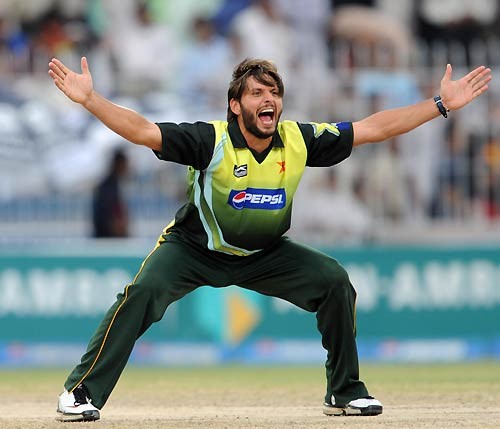
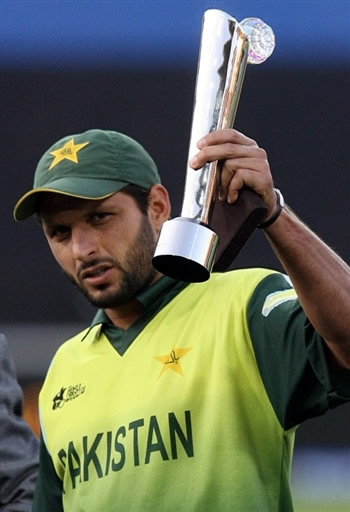
Sahibzada Mohammad Shahid Khan Afridi (born 1 March 1980 in Khyber Agency), popularly known as Shahid Afridi, is a Pakistani cricketer currently playing for the Pakistani national team in the international circuit. He made his ODI debut on 2 October 1996 against Kenya in Nairobi[1] and his Test debut on 22 October 1998 against Australia at Karachi.[2] He is known for his aggressive batting style, and currently holds the highest career strike rate in the history of international cricket. In a recent survey, Afridi was named as the most popular cricketer in Pakistan.[3] He also holds the record for the fastest one day century which he made in his debut innings, as well as scoring 32 runs in a single over, the second highest scoring over ever in an ODI.

Style

His general style of batting is very aggressive and attack oriented and has earned him the nickname “Boom Boom Afridi” for his fastest One Day International century just in 37 balls. As of 22 May 2007, he has an ODI strike rate of 109.38 runs per 100 balls, the highest in the game’s history. This attitude has been transferred to Test cricket as well, with Afridi scoring at a relatively high strike rate of 86.13 in Tests. He has an approach to batting that can change the tempo of a game and inspire the mood of an audience, as shown when a mass exodus of spectators occurred in Pakistan in late 2005 following his dismissal from the crease. He hits many sixes long and high, favoring straight down the ground or over midwicket. A trademark shot is a crossbatted flick to the leg-side to a ball outside off stump.[8]. This explosive style has led to some memorable shots, most notably the first ever 12 in power cricket in 2002, where Afridi successfully hit the roof. [9] However, his aggressive style increases his risk of getting out and he is one of the most inconsistent batsmen in cricket. This is reflected by the fact that he is the only player to score more than 5000 ODI runs at an average under 25.

Bowling-wise, his stock ball is the leg break, but his armory also includes the conventional off break and a ‘quicker one’ which he can deliver at nearly 80 mph in the style of a medium-pacer. He bowls at a high speed for a spinner, resulting in lesser turn, and relying more on variations in speed. He occasionally sends down a bouncer to a batsmen, which is very rare for a spin bowler.

International career

In October 1996 at the age of sixteen he was brought into the ODI team as a legspinner as a replacement for the injured Mushtaq Ahmed. He then gained notability as a pinch-hitter and began opening with Saeed Anwar. He holds the record for scoring the fastest century in one-day internationals (off 37 balls)[12], scored in only his second match and his first ODI innings. He also shares with Brian Lara the record for the third-fastest century in ODIs (off 45 balls). One of Pakistan’s most useful all-rounders, he has an extremely aggressive batting style, which has garnered him over 5,000 ODI runs (including an erstwhile world-record 249 sixes, recently broken by Sanath Jayasuriya), as well as taking over 250 wickets at ODI and 47 at Test level.

For various reasons, including a perception that he lacks patience in his batting, Afridi had limited opportunity in Test matches, although he currently averages in the high thirties and mid-thirties with bat and ball respectively. As it is, Afridi has featured in less than one third of the Test Matches played by Pakistan over the course of his career.[13] However, he made his presence felt in the third Test against India in March 2005, scoring a quick-fire second-innings half-century and taking five wickets in the match (including Tendulkar twice) to help Pakistan to win the game and register a series draw.

It is perceived that his batting struggles on bouncy pitches and against opponents like Australia, although his record against the Australians has improved over time. Although he has had success as an opener on sub-continent pitches, Afridi is often moved into the lower order as well.

Afridi was more consistent with his batting and bowling throughout 2005, starting with the tours of India and West Indies and through to the England tour. The Pakistani coach Bob Woolmer helped Afridi to reach a fuller potential by improving his shot selection and giving him free rein over his batting attitude.

In the 2007 World Twenty20, he performed poorly with the bat but brilliantly with the ball, earning the Man of the Series award, though he failed to take a wicket in the final and was out for a golden duck.

Career Highlights

* On 4 October 1996, playing his maiden international innings, Afridi hit the fastest One-Day century off 37 balls against Sri Lanka in Nairobi. His innings included 28 runs off one of Sanath Jayasuriya’s overs, whose record he broke. [15]

* Youngest player in history to make an ODI century at just 16 years and 217 days with his 37 ball ton against Sri Lanka. It included 11 sixes and 6 fours. [16]

* Made a half-century from 26 balls and took 3 second-innings wickets in Pakistan’s series-drawing Test victory against India in March 2005.[14]

* Holds the joint record with Brian Lara for the third fastest ODI century off 45 balls in April 2005 against India. [17] This actually was the first match that witnessed the Indian cricketer-turned-commentator Ravi Shastri make him the nickname Boom Boom Afridi.

* Equal highest aggregate sixes scored in the 50-over game, shared the legendary Sri Lankan batsman Sanath Jayasuriya, and he the most sixes per innings record.

* Scored four consecutive sixes off a Harbhajan Singh over in a Test match against India in January 2006, matching a feat that Kapil Dev achieved in 1990.

* Was the first player to score 12 runs off one ball, by hitting the roof of the Millennium Stadium. This took place in a game of Power Cricket.[citation needed][clarification needed]

* Holds four of the top eight fastest ODI half centuries, twice completed in 18 balls and twice in 20 balls. He has also scored a half century off just 21 balls.

* Made 32 runs off a Malinga Bandara over in an ODI game at Abu Dhabi in 2007. He struck four consecutive sixes and it was the 2nd most expensive over in ODI history.

* Afridi is only third player in ODI history to achieve the combination of 5000 runs and 200 wickets. The other players being Sri Lankan batsman Sanath Jayasuriya and South African Jacques Kallis.
Shahid Afridi
Shahid Afridi
Shahid Afridi
Shahid Afridi
Shahid Afridi
Shahid Afridi
Shahid Afridi
Shahid Afridi
Shahid Afridi makes 32 runs from 1 over vs Sri Lanka
Shahid Afridi : Fastest ODI Hundred